Our Location
304 North Cardinal St.
Dorchester Center, MA 02124
Where Rare Gems Find Their Place
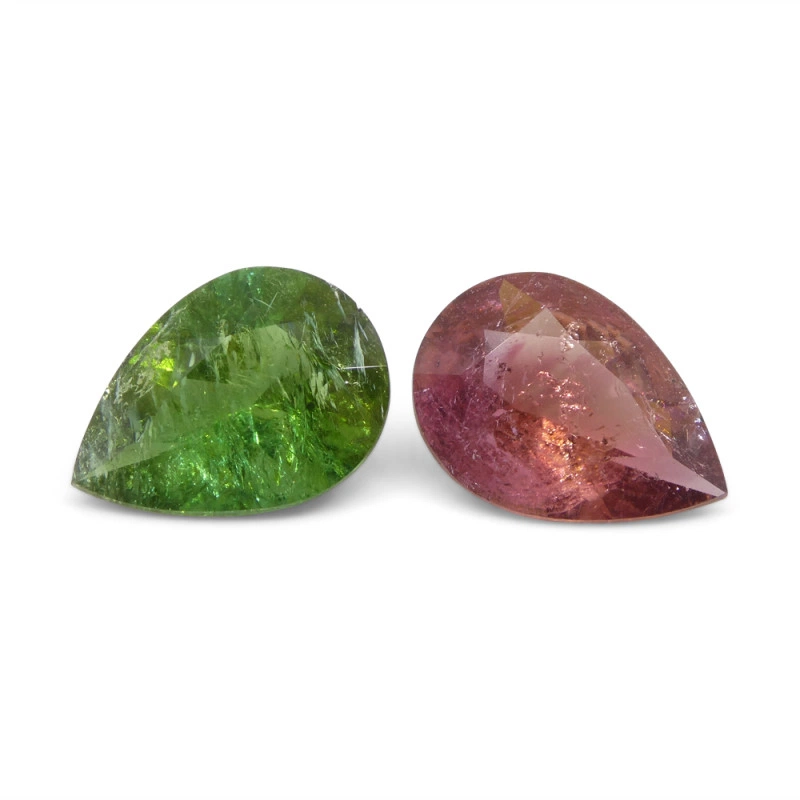
Explore one of the gem world’s broadest color palettes, from vivid green and blue to pink, red, watermelon and copper-bearing varieties. Learn how color, clarity, cut, carat weight, origin, treatments and care affect tourmaline.
Tourmaline is a group of related boron silicate minerals known for an exceptionally wide range of colors. Trace elements and structural differences can influence its appearance, which is why tourmaline can occur in vivid green, blue, pink, red, yellow, brown and multicolored forms.
GIA describes tourmaline as one of the gems with the widest color ranges. It is also the birthstone for October. GIA Tourmaline Encyclopedia.
Tourmaline can also be bi-color or tri-color. Watermelon tourmaline is especially recognized for a green outer zone and pink-to-red center.
Color is a major quality consideration for tourmaline. Saturation, tone and distribution can dramatically change appearance. Clarity, cut and carat weight also matter, and their relative importance can vary by variety.
GIA’s buyer guidance explains that color is the most important quality factor for tourmaline and that cut can strongly affect appearance. Read GIA’s Tourmaline Buyer’s Guide.
Tourmaline occurs in many parts of the world, including Brazil, Afghanistan, Kenya, Madagascar, Mozambique, Namibia, Nigeria, Pakistan, Russia, Sri Lanka, Tanzania, the United States and Zambia. Different localities produce different colors and material characteristics.
Brazil is particularly important for tourmaline, including the Paraíba region famous for copper-bearing blue-to-green material. Geographic origin should be supported by independent laboratory documentation when it is important to a purchase.
Some tourmaline may be heated or irradiated to alter color. Treatment disclosure is therefore an important part of buying. A recognized gemological report can identify the material as natural or laboratory-grown and report detectable treatments.
GIA notes that heat can damage tourmaline and that some irradiation-related color changes can be affected by heat or bright light. GIA Tourmaline Care & Cleaning.
Tourmaline ranks 7 to 7.5 on the Mohs hardness scale and has fair toughness. It is suitable for many jewelry applications, but high heat and sudden temperature changes should be avoided because they can damage the stone.
Warm, soapy water is the preferred cleaning method. GIA does not recommend ultrasonic or steam cleaning for tourmaline.
Tourmaline’s color diversity makes it versatile for rings, earrings, pendants and matched gemstone pairs. Matching pairs are particularly useful for earrings and symmetrical jewelry designs, where size, shape, color and cutting need to work together visually.
For a pair, inspect both stones together under consistent lighting. Similarity in hue, tone, saturation, dimensions and cut can be more important than simply matching carat weight.
Browse the GemsVault catalogue for current gemstone availability and continue with our Ruby, Diamond, Larimar, Opal and Cabochon guides.
Discover current natural gemstone listings and available Tourmaline pieces.


[…] PectoliteDistinctive natural color + patternCollector CharacterOften cut as polished […]