Our Location
304 North Cardinal St.
Dorchester Center, MA 02124
Where Rare Gems Find Their Place
Larimar is among the most visually distinctive gemstones and ornamental materials in the modern colored-stone market. Its blue to blue-green fields, pale clouding and natural patterning make every polished piece feel individual. Yet the beauty is only the beginning. Larimar is a blue variety of pectolite, a mineral with a very specific geological story centered on the Dominican Republic. This guide explains what Larimar is, why it is blue, where it forms, how its quality is assessed, how to buy it intelligently, and how to protect it for years.
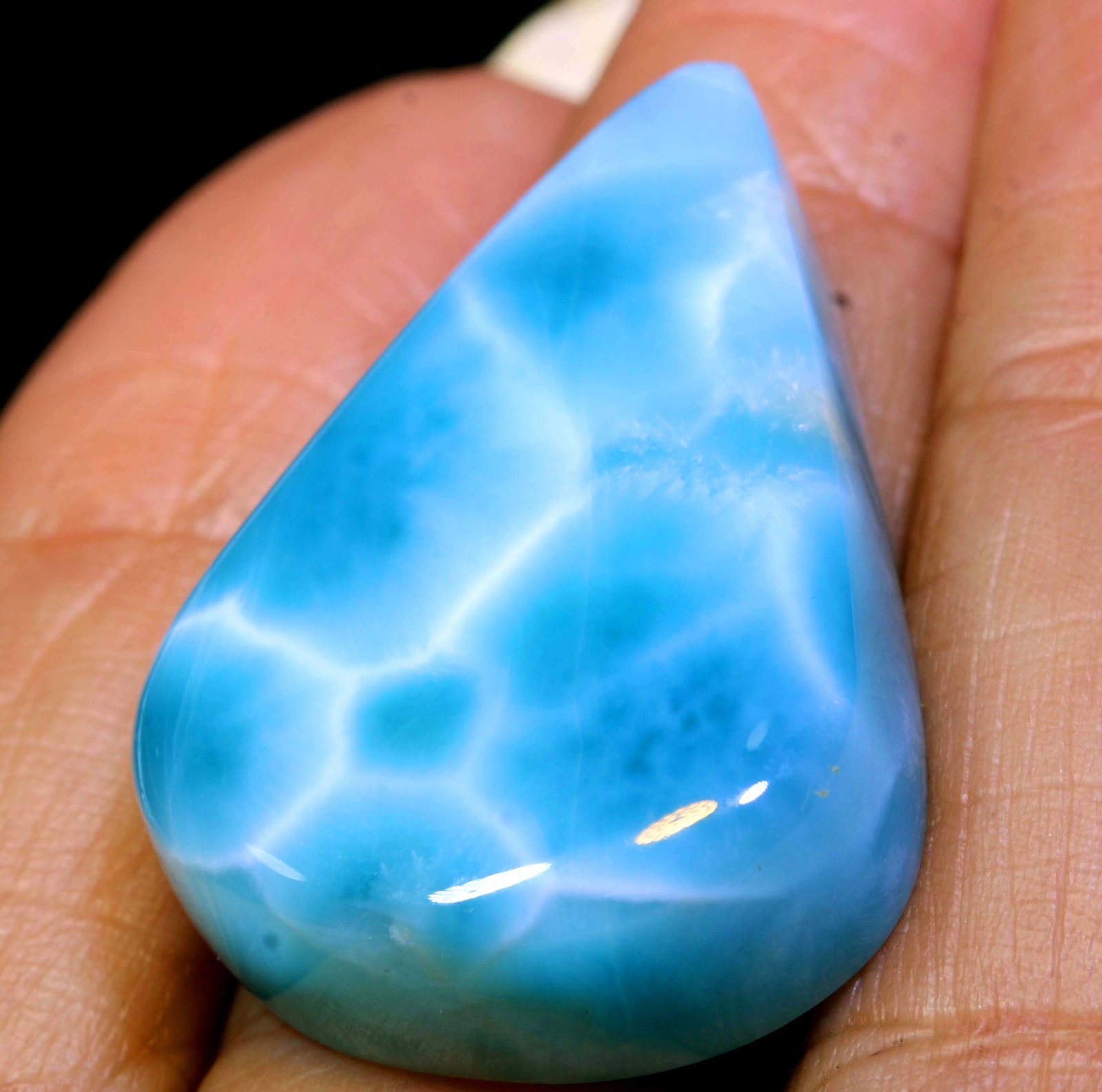
Larimar is the trade name used for a distinctive blue variety of the mineral pectolite. Pectolite is a calcium-bearing silicate mineral, and its compact blue Dominican material is the form that the jewelry and collector markets know as Larimar. This distinction is important because a gemstone’s trade name and mineral species are not always the same thing.
Professional gemology treats Larimar as an identifiable gem material rather than simply using “blue stone” as a visual description. The color may range from pale sky blue to stronger blue and blue-green tones, while natural white patterning can form clouds, waves, webs and irregular zones. The combination of material, color and pattern is a major part of Larimar’s appeal.
GIA has documented blue pectolite from the Dominican Republic under the trade name Larimar and notes that its blue color is believed to be related to small amounts of copper ions. GIA’s study also describes the material in cavities and veins of altered basalt.
Larimar has an unusually concentrated geographic identity. Gem-quality blue material is associated with the Barahona region of southwestern Dominican Republic. Scientific work describes bluish pectolite occurring in altered Cretaceous basalts and associated mineral assemblages.
A 2024 study in the Journal of South American Earth Sciences examined Larimar’s origin using mineralogy and geochemistry. Its abstract reports that volcanic and meteoric waters contributed to formation and that Larimar crystallized under relatively low-temperature conditions. It also describes green, blue and white pectolite appearing in altered volcanic rocks.
For buyers, origin gives important context. A blue-and-white cabochon should not be called Larimar merely because it visually resembles the material. Genuine identification is tied to the mineralogical identity and locality context rather than marketing appearance alone.
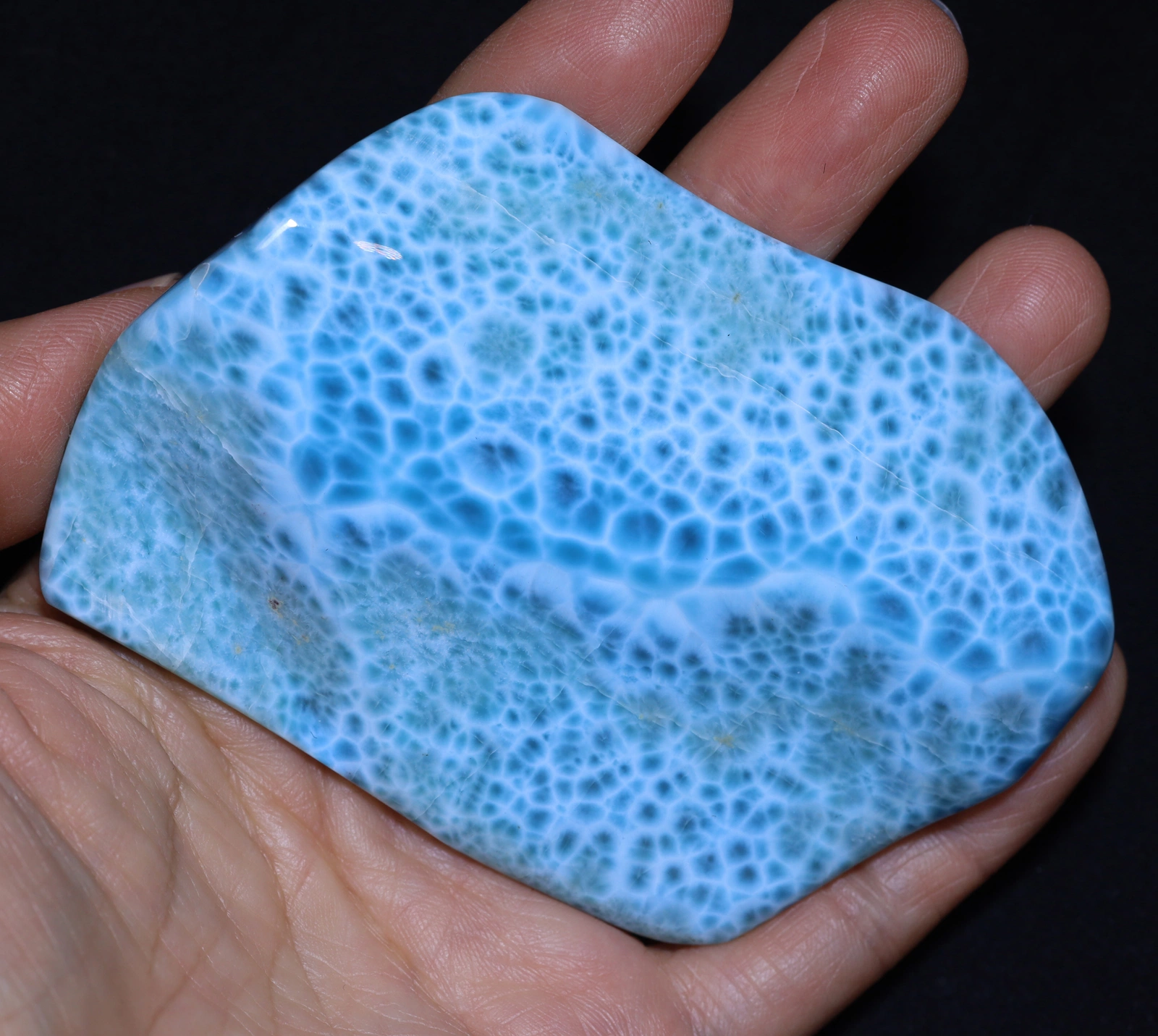
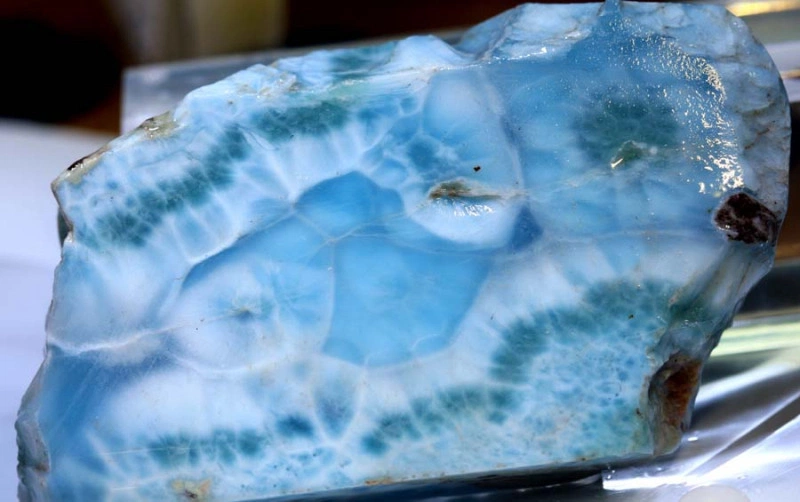
Larimar’s color is one of its defining characteristics. Gemological literature associates the blue color with small amounts of Cu²⁺ in the material. The result is a palette that can move from very pale blue to more saturated blue-green and deeper blue, often accompanied by white areas.
The natural pattern is equally important. Unlike a uniformly colored faceted gem, Larimar is commonly polished as a cabochon so the surface can display its internal zoning. White and blue areas may appear as soft clouds, wave-like bands, lace-like webs or irregular patches. A buyer should therefore evaluate the whole face of the stone instead of judging a single color word in a product title.
Consider whether the blue leans sky-blue, turquoise, blue-green or a deeper blue.
Stronger saturation can create more visual presence, but personal taste and pattern balance still matter.
Clouds, waves, webs and white zoning create the signature visual character of Larimar.
A smooth, well-polished surface allows the color and natural pattern to read clearly.
Larimar is often appreciated less for conventional faceted brilliance and more for the visual landscape created by its blue-and-white natural pattern.
Understanding durability and identity helps buyers select the correct use for a Larimar stone. Published gemological references report a relatively modest hardness compared with sapphire, ruby or diamond.
| Characteristic | Larimar / Pectolite Context |
|---|---|
| Mineral | Pectolite |
| Trade name | Larimar / blue pectolite |
| Color | White, blue, blue-green and mixed blue-white patterns |
| Blue color association | Small amounts of copper ions |
| Hardness | Approximately 4.5–6 reported for pectolite; compact Larimar is generally around 4.5–5 in many references |
| Transparency | Commonly opaque to translucent for Larimar material |
| Typical cutting | Cabochons, polished freeforms, hearts and decorative pieces |
| Major gem locality | Barahona area, Dominican Republic |
| Refractive index | Published pectolite ranges are approximately 1.595–1.645 |
| Specific gravity | Published pectolite references are approximately 2.74–2.90 |
The International Gem Society specifically notes that Larimar’s hardness can make it susceptible to scratches, recommends protective settings for rings, and identifies pendants and earrings as practical jewelry uses.
Larimar does not have a single universal grading system equivalent to a standardized diamond grading report. Quality is better understood through several observable characteristics that interact with one another.
Review hue, tone and saturation. Stronger blue can be visually striking, but balanced patterning may be equally important.
Examine the relationship between blue zones and pale or white areas. Contrast can make a piece feel much more dimensional.
A visually appealing pattern should suit the stone’s shape and intended setting rather than simply occupy one small corner.
Look for a smooth finish and clear disclosure of chips, fractures, cracks, pits or natural irregularities.
For cabochons, length, width and thickness are often more useful than carat weight alone when planning jewelry.
Ask how the stone is described, whether known treatment has been disclosed and what independent documentation exists when relevant.
Because Larimar is visually distinctive, imitations and look-alikes deserve careful attention. A blue-and-white appearance is not, by itself, sufficient proof of identity. Gemological publications have demonstrated ways to distinguish Larimar from other materials with similar appearance.
One useful GIA study compares Larimar with dyed chalcedony and notes the value of analytical identification. In a purchase where authenticity matters, a reputable gemological laboratory can provide stronger evidence than a generic marketplace description.
Treatment disclosure also matters. Buyers should distinguish natural from untreated. “Natural” normally describes origin as a naturally formed material, while “untreated” is a separate claim about enhancement. Listings should make that distinction clear where applicable.
The safest workflow for a higher-value purchase is simple: read the full listing, inspect the photographs, ask direct questions about treatment, review any report supplied, and use independent testing when the purchase amount or rarity justifies it.
Larimar’s moderate hardness makes jewelry design an exercise in balancing beauty with protection. Its cabochon-friendly pattern works particularly well when a setting gives the stone enough visual area to be appreciated while reducing unnecessary impact.
Rings experience frequent knocks and abrasion. A protective bezel or similarly sheltered design can be more suitable than a highly exposed setting. Even with a protective setting, Larimar should not be treated as a scratch-proof ring stone.
Pendants are particularly attractive for large, patterned Larimar because the stone can be displayed prominently while generally encountering less hard contact than a ring.
Earrings offer another practical format. They can showcase matched or complementary cabochons without subjecting the material to the level of abrasion commonly experienced by rings.
Large polished specimens, unusual patterns, freeforms and exceptional blue material can also appeal to collectors independently of jewelry use.
Larimar benefits from simple, gentle care. Avoid approaches designed for very hard gems and treat the stone more like a moderately delicate collectible or jewelry material.
There is no single universal Larimar price. Commercial value is influenced by color, pattern, size, dimensions, polish, condition, shape, treatment status, provenance and seller positioning. Market prices can also move over time, so a price seen today should be treated as a current asking price rather than a permanent valuation.
The live GemsVault Larimar category currently shows eight results, ranging from smaller gem-grade hearts and mid-size cabochons to very large polished stones. The selection provides a useful real-world example of how much asking prices can differ as stone size and format change.
Live catalogue snapshot — availability and pricing can change
These figures are a snapshot of the live GemsVault catalogue and are not a universal price guide. Before purchasing, check the current Larimar category for the latest availability and price.
A professional purchase process is less about chasing a single “best” specification and more about collecting enough information to understand the exact stone offered.
GemsVault describes itself as a curated gemstone marketplace focused on natural gemstones, rare collector stones and specialty gems. The live site connects shoppers to current product listings, gemstone categories, brands, services and customer information.
View the current Larimar listings, including natural and polished cabochons shown in the live catalogue.
Explore the wider GemsVault category library, including sapphire, ruby, emerald, opal and many specialist materials.
Browse current brand and collection information maintained on the GemsVault website.
Review available service information and ways GemsVault supports gemstone discovery and purchasing.
Learn more about the marketplace and its approach to natural gemstone discovery.
Use the contact page for questions about a particular gemstone or current listing.
Return to the live GemsVault Larimar archive to review the latest stones, dimensions, listing details and current prices.